

Mark Dvoretsky (1947-2016) was a Moscow trainer whose students won the World Junior Championship three times in four years, and whom the Russian Chess Federation called one of the most authoritative trainers in the world. His books are not all the same kind of book. Some are endgame references, some are exercise books, and some are memoirs. We stock seven titles by him or about him. This guide explains who he was, what each book is, and where to start.
Who he was
Dvoretsky was born in Moscow on 9 December 1947, and he was a strong player before he was a trainer. He was Moscow champion in 1973, shared fifth place in the 1974 USSR Championship, and won the B group at Wijk aan Zee in 1975 with 12 points from 15, a point and a half clear. He became an International Master that year, and in January 1976 he was ranked 37th in the world. Then he chose coaching over a playing career.
The results came quickly. His student Valery Chekhov won the World Junior Championship in 1975, Artur Yusupov in 1977 and Sergei Dolmatov in 1978. Later students included Alexey Dreev, Vadim Zvyagintsev, Viorel Bologan, Alexander Motylev and Ernesto Inarkiev. Stronger players came to him for short spells of work: in 1995 Veselin Topalov came to Moscow for a session on his endgames, and Dvoretsky said Topalov gained about 80 rating points in the following year. Anand and Bareev also consulted him. From 1990 to 1992 he and Yusupov ran a school for talented young players, and its material became their five-volume School of Future Champions. Yusupov, in a foreword, called him the best coach in the world.
His method rested on a card file. Positions were stamped on ordinary cards, his answer was handwritten on the back, and he noted which students had already solved each one. The cards were sorted by theme, and in his own words every position in his books had been tried out on his students first. The file is now in the Russian Chess Federation’s chess museum. He was named Honored Trainer of the USSR in 1990 and FIDE Senior Trainer in 2004, and he died in Moscow on 26 September 2016, aged 68.
The endgame books
Dvoretsky’s Endgame Manual, 6th Edition
Russell Enterprises (2025), 504 pages, revised by Karsten Müller with Alex Fishbein, with a foreword by Magnus Carlsen. The editors corrected errors reported by readers (sometimes changing an evaluation), added new theory and examples from recent top-level games, merged the rook-and-pawn against rook-and-pawn motifs into one section, and added exercises. The essential material is shaded in gray. Dvoretsky’s idea was that intermediate players would study only that shaded text. The book has a strong reputation: John Watson called the first edition a masterpiece of research and insight, Vladimir Kramnik called it a must for professionals and club players alike, and the US champion Alexander Shabalov named it as a rare book that players of many strengths can benefit from. The fair warning comes from the same direction. Watson also called it a terribly advanced work, and the ChessReads review of this edition rates it for players of 2000 and above.
There is a 15-page sample on the product page.
Dvoretsky’s Endgame Manual: FastTrack Edition
Russell Enterprises (2021), 216 pages, with a foreword by Ian Rogers. Karsten Müller and Alex Fishbein built it from the gray-shaded essential text of the fifth edition, kept practical examples where they were needed, and added 60 graded exercises. Its introduction addresses it to readers who have not yet reached master or expert level, and Rogers suggests it can be an amateur’s only endgame book or a stepping stone to others. One thing to know: it was made before the 2025 revision, so it does not include the sixth edition’s corrections.
Mark Dvoretsky and Oleg Pervakov, an International Grandmaster of chess composition, with a foreword by Jan Timman. First published in 2009, about 210 pages. It uses endgame studies, solved and played out, to train calculation and resourcefulness in tournament players. It has four parts, including the studies from a composing tournament held for Dvoretsky’s 60th birthday and a final 47-page chapter of studies composed by practical players, among them most of the world champions. Sean Marsh called it a fine book, and also not one for the lazy. A second volume, completed by Pervakov alone after Dvoretsky’s death, came out in 2024 with a foreword by Garry Kasparov; we do not currently stock it.
For endgame books by other authors, see our endgame books guide.
Testing yourself

Russell Enterprises (2019), 208 pages, translated by Boris Gleyzerov, with a foreword by Artur Yusupov. Dvoretsky finished the manuscript but died before he could write a foreword, so this is the last of his books. It has 39 tests in seven chapters: combinational vision, candidate moves, calculating variations, attack and defense, positional play, realizing an advantage, and endgames. Each test is a page of positions, and the solutions take up most of the book. Most of the positions come from his card file, and some appeared in his earlier books. In the solutions he tries to show how to find the move, not just what it is. It is demanding: he warns that two of the tests need at least an hour and a half even for strong players.
There is a 15-page sample on the product page.
Memoirs, essays and a tribute
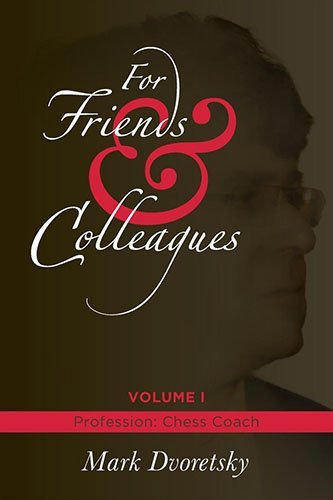
For Friends & Colleagues, Book 1: Profession: Chess Coach
Russell Enterprises (2014), 384 pages, with a foreword by Yusupov. Dvoretsky says it is neither a textbook nor an autobiography in the usual sense, and that it is not for everyone. It is his story as a coach, built around his early work with Yusupov and Dolmatov, with chapters on Tal, the Botvinnik school, Dreev, major matches and his trips to America. Many diagrams are marked as exercises. John Hartmann, reviewing it in Chess Life, said it will not help you improve but is hard to beat as first-hand chess history. He also warned that it settles scores: Tal and Gulko come off well, Botvinnik less so, and Dvoretsky is severe about Josh Waitzkin’s account of their work in The Art of Learning.
There is a 16-page sample on the product page.
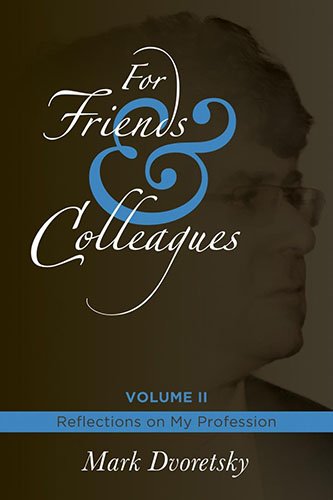
For Friends & Colleagues, Book 2: Reflections on My Profession
Russell Enterprises (2015), 360 pages, translated by Boris Gleizerov. Articles and interviews in three sections: competitions, chess literature (what to read and how), and training. Topics include rapid chess and anti-draw rules. By his own account it has no purely analytical studies, although the competitions section does include annotated games and analysis of matches. One reviewer called it a niche book for coaches, trainers and Dvoretsky devotees, and found the two later sections the most valuable.
There is a 15-page sample on the product page.
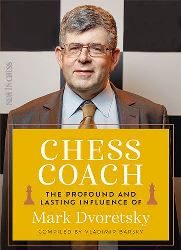
Chess Coach: The Profound and Lasting Influence of Mark Dvoretsky
Compiled by Vladimir Barsky (New in Chess, 2024), 328 pages. A largely unabridged translation of a Russian memorial book published in 2018 for what would have been his 70th birthday. Garry Kasparov’s foreword presents it as a reply, from friends and colleagues, to Dvoretsky’s own For Friends and Colleagues. There are four parts: memories from his contemporaries, 39 of his own games annotated by him and by former students, endgame studies, and his interviews and articles. Matthew Sadler found it very pleasant to browse, and John Donaldson wrote that it belongs in every chess player’s library.
There is a 16-page sample on the product page.
Where to start
If you are a club player, start with the FastTrack Edition. It was made for readers below expert level, and it is the part of the Manual that Dvoretsky meant intermediate players to study. If you are rated around 2000 or more, or want the complete reference, buy the sixth edition instead. Chess Tests suits ambitious players who want to measure themselves, though some tests are hard even for strong players. If you want to know the man rather than study his method, read For Friends & Colleagues, Book 1, or Barsky’s Chess Coach.
His other books
Several of his well-known books are not on our shelves, but you will see them mentioned, and their titles changed between publishers, so here is how they fit together.
The Batsford books (1991-1998). His English career began with Secrets of Chess Training (1991), named the British Chess Federation’s Book of the Year, and Secrets of Chess Tactics (1992). Then came five books written with Yusupov: Training for the Tournament Player, Opening Preparation, Technique for the Tournament Player, Positional Play, and Attack and Defence.
School of Chess Excellence (Edition Olms, 2001-2003), four volumes: Endgame Analysis, Tactical Play, Strategic Play and Opening Developments. Dvoretsky described the four as really one large book, his first, and the first volume is a new version of Secrets of Chess Training.
School of Future Champions (Edition Olms, with Yusupov, 2006-2009), five volumes: Secrets of Chess Training, Secrets of Opening Preparation, Secrets of Endgame Technique, Secrets of Positional Play and Secrets of Creative Thinking. These are new editions of the Batsford books the two wrote together; the fifth, for example, is Attack and Defence.
Later books from Russell Enterprises. Dvoretsky’s Analytical Manual (2008, second edition 2013), which he aimed mainly at strong players and Jeremy Silman recommended for players rated 2200 and above; Tragicomedy in the Endgame (2011), an introduction to the Endgame Manual built on mistakes by masters; Recognizing Your Opponent’s Resources (2015) and Maneuvering (2016), two exercise books with the same plan of a short introduction, exercises from elementary to difficult, and full solutions; and Chess Lessons (2018), aimed mainly at strong players but also at any serious self-improver.