


The Dutch starts 1.d4 f5. Black stakes a claim to e4 from the side and accepts a slightly loose king in return for an unbalanced game. It has never been a main line against 1.d4 and is rare at elite level, though it has had serious users: Botvinnik and Bronstein both played it in their 1951 world championship match, and Magnus Carlsen beat Anand and Caruana with the Stonewall in 2015.
There are three main systems. In the Leningrad, Black fianchettoes on g7 and usually plays …d6. In the Stonewall, Black sets pawns on c6, d5, e6 and f5 to hold e4, often putting a knight there. The Classical is everything else, typically …e6, …Be7 and …d6. Before any of these, White can try to avoid the Dutch altogether: with the Staunton Gambit 2.e4, with 2.Bg5, with 2.Nc3, or with a London setup and Bf4. A repertoire needs answers to those as well.
We have chosen the books below for being reasonably current and for what reviewers have said about them. We stock a few older Dutch repertoire books that are not included here.
An overview of all the systems
Viktor Moskalenko (New in Chess, 2014). 272 pages covering White’s anti-Dutch systems (the gambits, 2.Nc3, 2.Bg5), the fianchetto structures, and the Stonewall, Classical and Leningrad. It is not a repertoire book: it surveys the whole opening, and it is useful from White’s side as well. Its theory dates from 2014, so read it for the ideas and check the concrete lines in one of the newer books below.
The Leningrad
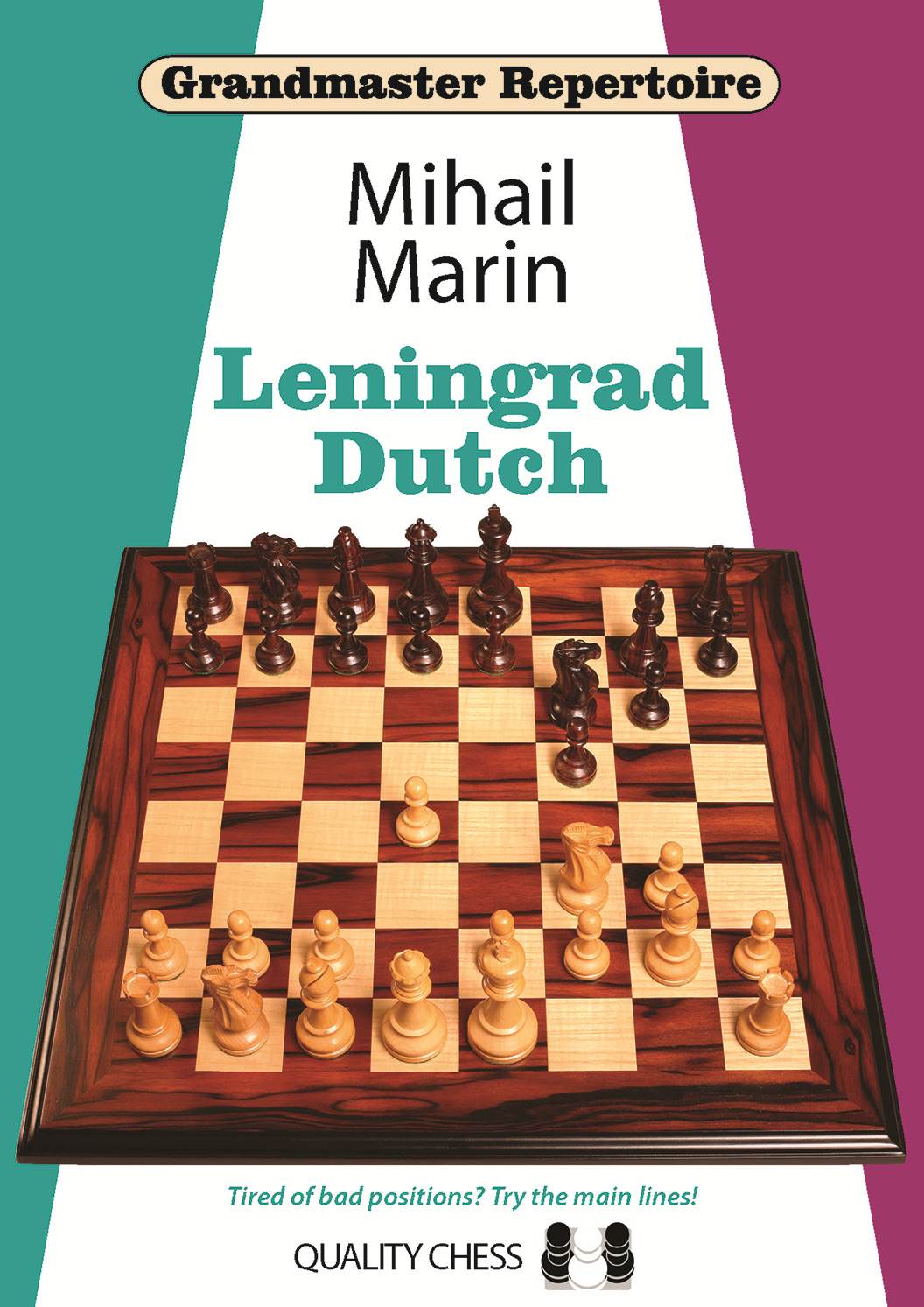
Grandmaster Repertoire: The Leningrad Dutch
Mihail Marin (Quality Chess, 2021). 344 pages on the lines where White fianchettoes the king’s bishop. Against the main line, 1.d4 f5 2.g3 Nf6 3.Bg2 g6 4.Nf3 Bg7 5.0-0 0-0 6.c4 d6 7.Nc3, Marin recommends 7…Qe8, with 8.d5 Na6 as the main line. There are separate chapters on White’s other sixth moves and the rarer fianchetto lines. It is a detailed repertoire book; if you have never played the Leningrad, The Diamond Dutch above is the gentler place to start.
There is a 15-page sample on the product page.
Grandmaster Repertoire: Dutch Sidelines
Mihail Marin (Quality Chess, 2021). The companion volume, 304 pages, for everything where White does not fianchetto: 2.c4 lines, 2.Bg5, 2.Nc3 and the gambits. The Staunton Gambit gets a chapter of its own, and the book also shows how to meet 1.Nf3 and 1.c4 in Dutch style. Against 2.c4 Nf6 3.Nc3 Marin chooses 3…g6. The London setup with 2.Bf4 is handled inside a chapter on rare second moves, so it gets less space than the 2024 book below, which is devoted to it. You need both volumes for a complete Leningrad repertoire.
There is a 13-page sample on the product page.
The Stonewall

Nikola Sedlak (Quality Chess, 2020). A full Stonewall repertoire in 328 pages, including the anti-Dutch lines and White’s move-order tricks. A review on the Forward Chess blog called it a very good choice both for experienced Dutch players and for newcomers, and said Sedlak is honest about White’s options even though he writes for Black. Forward Chess sells the ebook, so that review is not fully independent.
There is a 16-page sample on the product page.

The Modernized Stonewall Defence
Milos Pavlovic (Thinkers Publishing, 2020). About 200 pages on the main-line Stonewall, with both …Be7 and …Bd6 setups, plus White’s systems that avoid the main line: the London, e3 systems, Nc3 lines and irregular third moves. It does not cover White’s second-move alternatives such as 2.Bg5, 2.Nc3 and 2.e4, so it is not a complete Dutch repertoire on its own. It is shorter than Sedlak and narrower.
There is a 16-page sample on the product page.
For White against the Dutch

Kiril Georgiev (Chess Stars, 2024). About 200 pages, the newest Dutch book we stock. A White repertoire against every Dutch system built on 1.d4 f5 2.Bf4, including the move orders Dutch players use to keep their options open, such as 1.d4 e6 2.Nf3 f5 3.Bf4 and 1.d4 d6 2.Nf3 f5 3.Bf4. Against the Leningrad the plans include h4, Qf3 and long castling. The publisher says the line is little explored and that engines favor White; that is the publisher’s claim, and we have not yet found an independent review of the book.
There is a 14-page sample on the product page.

Beat the Dutch Defense: A Killer Weapon
Jan Boekelman (Thinkers Publishing, 2022). A White repertoire built on the Staunton Gambit, 1.d4 f5 2.e4. After 2…fxe4 3.Nc3 Nf6 the main weapon is 4.Bg5, with 4.f3 and 4.g4 as alternatives. One example of the book’s approach: it recommends 6.Qe2 rather than the traditional 6.Qd4, because after 6.Qd4 Nf7 Black can hit the queen with a timely …e5. The Staunton has been out of favor for a long time; the publisher notes it has made a comeback in faster games. One practical limit: a Black player who starts with 1…e6 and plays …f5 only after 2.c4 or 2.Nf3 never gives you the chance to play it.
There is a 16-page sample on the product page.